THE TECHNOLOGICAL UNIVERSITY OF TAJIKISTAN AND THE 35TH ANNIVERSARY OF NATIONAL INDEPENDENCE
During the years of independence, the Technological University of Tajikistan has become a leading center for training highly qualified personnel for the industrial, economic and digital sectors.
The university’s activities are carried out in accordance with the directives and instructions of the Founder of Peace and National Unity — the Leader of the Nation, the President of the Republic of Tajikistan, Emomali Rahmon — and are aimed at implementing national strategies, in particular the ‘Years of Industrial Development (2022–2026)’ and the ‘Years of Digital Economy and Innovation Development (2025–2030)’. In this regard, a new phase of the University’s Development Strategy, extending to 2030, has been drawn up and approved.
The University was founded on 20 September 1990 by Resolution No. 207 of the Council of Ministers of the Tajik SSR as a Higher Technological College, and on 29 July 1991, pursuant to Decision No. 530 of the Council of Ministers of the Union of Soviet Socialist Republics (USSR) No. 530, it was transformed into the Institute of Light Industry and Food Technology, and on 19 February 1993, by Decision No. 80 of the Council of Ministers of the Republic of Tajikistan, it became the Technological University of Tajikistan. Branches of the university were opened in the cities of Khujand (1993) and Kulob (2003).
Stages of development:
1990–1993: Formation and legal establishment.
1993–2005: Strengthening the educational base for light industry and the food sector.
2005–2020: Transition to a credit-based education system; development of bachelor’s, master’s and doctoral programs.
2021–2026: A phase of innovative development, digitalization and internationalization.
Throughout its history, the university has educated more than 20420 graduates, of whom 17767 are bachelors, 653 are masters, and 700 graduated with excellence.
Today, the university employs 199 full-time academic staff, including 17 Doctors of Science, 97 Candidates of Science, 49 senior lecturers and 36 teaching assistants. The qualification level stands at 57.3 per cent.
Key figures: 8 faculties, 20 departments, 4 centers, a Master’s department, a Doctoral department, a branch in Isfara and the state educational institution ‘Dushanbe Innovative Lyceum’ under the Technological University of Tajikistan. 17 branches of relevant departments have been established at companies.
In 2024, the university was accredited and awarded a new license: 58 bachelor’s degree programs, 38 master’s programs, 18 doctoral programs, 22 traditional postgraduate programs and 30 short courses.
These include 37 programs directly aimed at implementing the Strategy for Accelerated Industrialization: 13 programs in the light industry sector, 12 in the food industry, 7 in the ICT sector and 5 in the field of artificial intelligence and drones.
Digitalization: fibro-optic networks, a high-performance server, a new website with a chatbot, an electronic library with a collection of over 1 million books, a unified learning management platform, ID cards, a facial recognition system, cashless payments, 900 computers, 26 lecture classrooms, 25 computer labs and 54 multimedia classrooms.
The university has introduced new degree programs to meet the needs of the digital economy: ‘Artificial Intelligence’, ‘Applications of Drone Technology’ ‘Industrial Robots and Robotic Systems’, ‘Digital Economy’, ‘Smart Devices, Machines and Manufacturing’, and others.
The university rose from 13th to 6th place in the national rankings. In Interfax’s ranking of the 400 best universities in the CIS, it took 151st place and was awarded the IAAR-EUR ‘Star of Quality’ award.
The university received international accreditation certificates from the Independent Agency for Accreditation and Ranking (IAAR) of Kazakhstan for two study programs in 2020, valid for a period of five years. This was the first such achievement for the university and, at that time, the first case of such recognition in Tajikistan.
On 24 September 2026, by decision of the IAAR Accreditation Council, the university was awarded a *Certificate of International Institutional Accreditation* valid for five years. The certificate was presented to the Rector, Rahmonzoda Z.F., on 2–3 October 2026 during the 10th Central Asian International Forum in Astana.
The significance of this achievement:
Science and innovation: Priority is given to applied research, inventive activity, the development of sector-specific laboratories, digital technologies and start-ups.
Cooperation with industry: The university has signed agreements with 170 organisations, 56 of which are industrial companies. From the 2024–2025 academic year, dual education programmes have been introduced, and 17 branches of specialist departments have been opened on company bases.
International cooperation: 100 agreements with universities from 30 countries, and 10 international projects (Erasmus+, GIZ, JICA, KOICA, the World Bank, UNESCO, etc.). The Korean-Tajik Centres and the Korean Language Centre are actively functioning. Geographical cooperation: Germany, Italy, Spain, Poland, South Korea, China, India, Russia and the countries of Central Asia.
Educational activities are aimed at fostering patriotism, national identity and civic responsibility, and events dedicated to the 35th anniversary of independence play an important role in this regard.
Infrastructure: 133 teaching rooms with a total capacity of 3380 places (1,815 for lectures, 625 for practical sessions, 598 for computer-based work and 342 for laboratory work).
Development prospects up to 2030:
– Aligning study programmes with the requirements of the labour market;
– Developing specialisations in engineering, artificial intelligence and automation;
– Strengthening the dual education system and supporting start-ups;
– Expanding international partnerships;
– Modernising laboratories and the digital environment;
– Monitoring the quality of education and graduate employment.
The Technological University of Tajikistan sees the key to its sustainable development in a combination of high-quality education, scientific and innovative potential, and modern infrastructure.
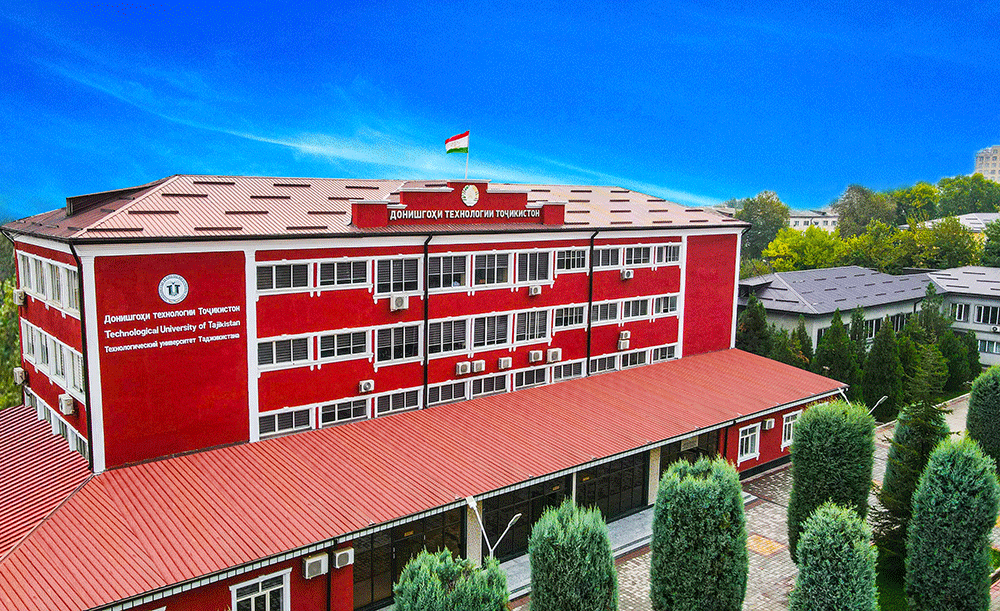
Everyone who visits the university campus is enchanted by its green spaces, bright colours and exemplary cleanliness, and falls in love with this place of study and learning. This beauty and freshness remain in their memories forever. In terms of its landscaping and greenery, the university campus is on a par with the capital’s finest cultural gardens. It is precisely this landscaping, the daily work involved in planting and maintaining the grounds — all of this is being done to properly celebrate the great anniversary of the 35th anniversary of the Republic of Tajikistan’s independence, which for the university represents not only the culmination of its achievements but also the beginning of a new stage of development, as well as a contribution to the country’s digital economy and rapid industrialisation.